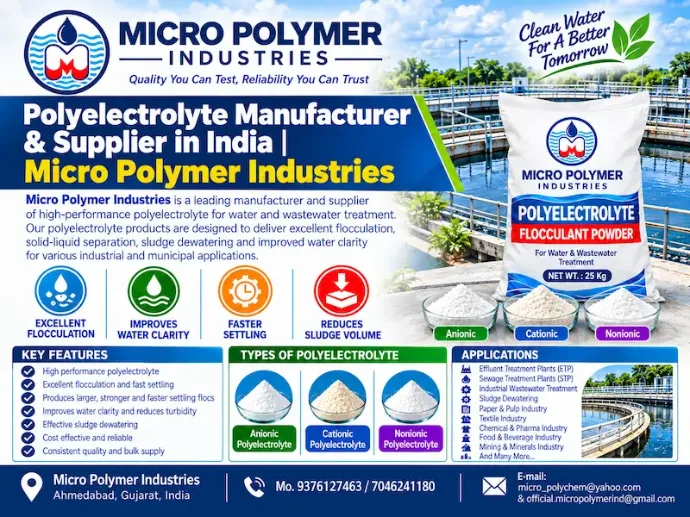
Polyelectrolyte Manufacturer & Supplier in India | Micro Polymer Industries
Micro Polymer Industries is a manufacturer and supplier of Polyelectrolyte chemicals, Polyacrylamide (PAM) and industrial flocculants for water treatment, wastewater treatment and solid-liquid separation applications.
We manufacture and supply Anionic Polyelectrolyte, Cationic Polyelectrolyte and Nonionic Polyelectrolyte in suitable grades for different industrial wastewater and process requirements.
Based in Ahmedabad, Gujarat, Micro Polymer Industries supplies polyelectrolyte chemicals to customers across Gujarat and major industrial regions throughout India.
Industries Using Polyelectrolyte
Micro Polymer Industries supplies polyelectrolyte chemicals for a wide range of industries:
- Textile Industry
- Dyeing & Printing Industry
- Chemical Industry
- Pharmaceutical Industry
- Paper & Pulp Industry
- Mining & Minerals
- Ceramic Industry
- Food Processing
- Dairy Industry
- Sugar Industry
- Distillery
- Fertilizer Industry
- Petrochemical Industry
- Oil & Gas
- Sand Washing
- Stone Processing
- Municipal Wastewater Treatment
- Infrastructure Projects
What is Polyelectrolyte?
Polyelectrolyte is a water-soluble polymer widely used as a flocculant and separation aid in water and wastewater treatment.
Depending on its ionic nature, molecular characteristics and application, polyelectrolytes can help suspended particles aggregate into larger flocs, making them easier to remove through sedimentation, clarification, filtration or dewatering.
Industrial polyelectrolytes are commonly available as:
- Anionic Polyelectrolyte
- Cationic Polyelectrolyte
- Nonionic Polyelectrolyte
- Dewatering Polyelectrolyte
- Deoiling Polyelectrolyte
- Application-specific Polyacrylamide grades
Polyelectrolyte Products by Micro Polymer Industries
1. Anionic Polyelectrolyte
Anionic Polyelectrolyte / APAM is a negatively charged water-soluble polymer used extensively for flocculation, clarification and solid-liquid separation.
Applications include:
- ETP wastewater treatment
- STP & WWTP
- Mining & mineral processing
- Sand washing
- Ceramic wastewater
- Paper industry
- Textile wastewater
- Clarifier applications
- Thickener systems
- Tailings treatment
- Solid-liquid separation
It is particularly useful where particle bridging and rapid formation of larger flocs are required.
2. Cationic Polyelectrolyte
Cationic Polyelectrolyte / CPAM carries a positive charge and is commonly selected for sludge conditioning, sludge dewatering and solid-liquid separation.
Applications include:
- ETP sludge dewatering
- STP sludge treatment
- Municipal wastewater
- Filter press
- Belt filter press
- Screw press
- Centrifuge
- Dairy wastewater
- Food industry
- Pharmaceutical wastewater
- Textile wastewater
- Industrial sludge treatment
The appropriate cationic grade depends strongly on sludge characteristics and dewatering equipment.
3. Nonionic Polyelectrolyte
Nonionic Polyelectrolyte / NPAM is a neutral polymer used for specialized flocculation and solid-liquid separation applications.
It can be considered for:
- Chemical wastewater
- Mineral processing
- Acidic wastewater
- Metal processing
- Special industrial effluents
- Fine particle separation
- Selected oil-field applications
The actual performance depends on water chemistry and the specific contaminant.
Polyelectrolyte Powder
Micro Polymer Industries supplies Polyelectrolyte Powder in Anionic, Cationic and Nonionic grades for industrial water and wastewater treatment.
Typical characteristics
| Property | Typical Description |
|---|---|
| Product | Polyelectrolyte / Polyacrylamide |
| Form | Free-flowing powder |
| Types | Anionic / Cationic / Nonionic |
| Solubility | Water soluble |
| Molecular Weight | Grade/application dependent |
| Ionic Nature | Charge-dependent |
| Application | Flocculation & solid-liquid separation |
| Packaging | Standard & customized bulk packing |
| Supply | Bulk / industrial quantities |
Polyelectrolyte Liquid
For customers requiring liquid polymer systems, Micro Polymer Industries also supplies Liquid Polyelectrolyte / Liquid Flocculant in application-specific grades.
Liquid polyelectrolyte can be considered where customers prefer:
- Easier dosing
- Reduced powder handling
- Continuous chemical dosing
- Automated dosing systems
- Ready-to-use or concentrated liquid formulations
- Industrial wastewater treatment
Liquid grades can be supplied in suitable Anionic, Cationic or Nonionic formulations, subject to application requirements.
Polyelectrolyte for Wastewater Treatment
Polyelectrolytes are widely used in wastewater treatment to improve floc formation and solid-liquid separation.
They can help with:
- Suspended solids removal
- Turbidity reduction
- Faster settling
- Clarifier performance
- Sludge thickening
- Sludge dewatering
- Filter press performance
- Belt press operation
- Centrifuge dewatering
- Water recycling
- Filtration efficiency
Polyelectrolyte for ETP
Polyelectrolyte for ETP is used to improve flocculation and separation of suspended solids from industrial effluent.
Common applications include:
Chemical ETP | Textile ETP | Pharmaceutical ETP | Food ETP | Dairy ETP | Paper ETP | Ceramic ETP | Sugar ETP | Distillery ETP | Agrochemical ETP
The appropriate polymer may be Anionic, Cationic or Nonionic, depending on the wastewater chemistry and treatment stage.
Polyelectrolyte for STP & Sludge Dewatering
For STP and municipal wastewater systems, polyelectrolytes are commonly used for sludge conditioning and dewatering.
Depending on the sludge characteristics and equipment, suitable polymer selection can help improve:
- Solids capture
- Floc strength
- Filtration
- Cake formation
- Water release
- Dewatering efficiency
How Does Polyelectrolyte Work?
Polyelectrolytes work primarily through charge interaction and polymer bridging.
During treatment, polymer molecules interact with fine suspended particles and colloids. These particles aggregate into larger flocs that can be separated more easily by:
Coagulation → Flocculation → Settling → Filtration / Dewatering
Performance depends on factors such as:
- Polymer type
- Ionic charge
- Molecular weight
- Wastewater pH
- TSS concentration
- Particle characteristics
- Coagulant used
- Polymer dosage
- Mixing conditions
- Settling time
- Dewatering equipment
Key Benefits of Micro Polymer Industries Polyelectrolyte
High Flocculation Efficiency
Designed to promote strong floc formation and efficient particle aggregation.
Improved Solid-Liquid Separation
Helps separate suspended solids from treated water.
Faster Settling
Suitable grades can improve settling behaviour in clarification systems.
Sludge Dewatering
Cationic and application-specific grades can assist sludge conditioning and water release.
Lower Chemical Consumption
Effective polymer selection can reduce overall treatment chemical consumption.
Better Filtration
Improved floc formation can support filter press, belt press and other separation equipment.
Application-Specific Grades
Different molecular weight and ionic characteristics can be evaluated according to application requirements.
Bulk Industrial Supply
Suitable for regular industrial and bulk procurement requirements.
Anionic vs Cationic vs Nonionic Polyelectrolyte
| Type | Charge | Common Applications |
|---|---|---|
| Anionic Polyelectrolyte | Negative | Clarification, mining, mineral processing, ETP, sand washing |
| Cationic Polyelectrolyte | Positive | Sludge dewatering, STP, ETP sludge, filter press |
| Nonionic Polyelectrolyte | Neutral | Specialized wastewater, minerals, chemical processes |
| Dewatering Polymer | Application dependent | Filter press, belt press, centrifuge |
| Deoiling Polymer | Application dependent | Oil-water separation |
Polyelectrolyte Dosage
There is no single universal dosage for polyelectrolyte.
The optimum dosage depends on:
- TSS
- Turbidity
- Sludge concentration
- pH
- Particle size
- Organic load
- Type of coagulant
- Polymer charge
- Molecular weight
- Mixing conditions
- Treatment equipment
For this reason, Micro Polymer Industries recommends jar testing or application trials before fixing the commercial dosage.
Why Choose Micro Polymer Industries?
Manufacturer & Supplier
Micro Polymer Industries manufactures and supplies industrial water and wastewater treatment chemicals from Ahmedabad, Gujarat.
Since 1992
Serving industrial customers with water and wastewater treatment chemicals since 1992.
Multiple Polymer Types
Anionic, Cationic, Nonionic and application-specific polyelectrolyte grades.
Technical Product Selection
Support for selecting polymer grades based on application and treatment requirements.
Bulk Supply
Suitable for regular industrial procurement and bulk requirements.
Customized Solutions
Polymer grade selection can be evaluated according to wastewater, sludge and process conditions.
Pan-India Supply
Supply network covering Gujarat and industrial regions across India.
Polyelectrolyte Manufacturer in Ahmedabad, Gujarat
Micro Polymer Industries is based in Ahmedabad, Gujarat, and supplies polyelectrolyte chemicals to major industrial areas including:
Ahmedabad | Sanand | Vatva | Naroda | Kathwada | Odhav | Changodar | Morbi | Rajkot | Vadodara | Bharuch | Ankleshwar | Vapi | Surat | Dahej | Jamnagar | Bhavnagar | Gandhinagar
Bulk Polyelectrolyte Supplier Across India
Micro Polymer Industries supplies polyelectrolyte chemicals to industrial customers across:
- Gujarat
- Maharashtra
- Rajasthan
- Madhya Pradesh
- Uttar Pradesh
- Delhi NCR
- Haryana
- Punjab
- Tamil Nadu
- Karnataka
- Telangana
- Andhra Pradesh
- West Bengal
- Odisha
- Chhattisgarh
- Jharkhand
- Bihar
- Uttarakhand
- Himachal Pradesh
Quality & Product Selection
For industrial polyelectrolytes, product performance is influenced by several parameters rather than just appearance.
We can evaluate requirements based on:
- Ionic nature
- Molecular weight
- Charge density
- Degree of hydrolysis
- Dissolution behaviour
- Floc formation
- Settling performance
- Dewatering performance
- Application-specific requirements
Polyelectrolyte Packaging
Polyelectrolyte can be supplied in suitable industrial packaging according to product form and customer requirement.
Powder: Standard industrial bags / customized packing / 25kg Bag regular
Liquid: Suitable drums / containers / bulk packing depending on grade and quantity / 50kg Can regular
For bulk requirements, please mention the required packing size and monthly consumption while requesting a quotation.
Polyelectrolyte & Industrial Water Treatment Chemical Solutions
Anionic Polyacrylamide | Cationic Polyacrylamide | Nonionic Polyacrylamide | Polyelectrolyte | Flocculants | Coagulants | Dewatering Polyacrylamide | Deoiling Polyacrylamide | Partially Hydrolysed Polyacrylamide | Defoamer | Antiscalant | Polyamine | Polydadmac
Request Sample | Get Bulk Price | Request Quotation
CALL / WHATSAPP NOW +91 9376127463 +91 7046241180
EMAIL micro_polychem@yahoo.com
Frequently asked questions
Polyelectrolyte is a water-soluble polymer used primarily for flocculation, clarification, solid-liquid separation and sludge dewatering in water and wastewater treatment.
Many industrial water-treatment polyelectrolytes are Polyacrylamide-based polymers (PAM). However, product chemistry and ionic characteristics vary by grade and application.
The main industrial types are Anionic, Cationic and Nonionic Polyelectrolytes.
There is no single best polymer for every ETP. The correct grade depends on wastewater chemistry, TSS, pH, particle characteristics and treatment process. Jar testing is recommended.
Yes. Micro Polymer Industries supplies industrial Anionic, Cationic and Nonionic Polyelectrolyte Powder in suitable grades.
Anionic polyelectrolytes are widely used for clarification, flocculation, mineral processing, mining, sand washing, paper applications and various industrial wastewater treatment processes.
Yes. Liquid polyelectrolyte/flocculant grades can be supplied according to application and formulation requirements.
Yes. Micro Polymer Industries supplies polyelectrolyte for industrial and bulk requirements across India.
Yes. Send the competitor's product name, TDS, COA, specification or test report. The technical team can evaluate a suitable equivalent grade.
Share your application, wastewater/sludge details, pH, TSS, current polymer, equipment and required quantity. Where possible, jar testing or application testing should be conducted before finalizing the grade.
Product required + application + quantity + location + existing grade/brand (if any).
For technical selection, additionally send TDS/COA, wastewater parameters or sludge details.
Micro Polymer Industries supplies polyelectrolytes across Gujarat and major industrial regions throughout India.