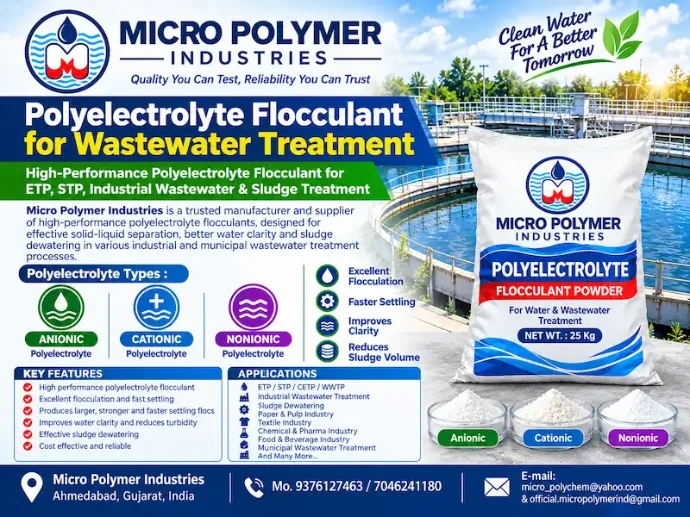
Polyelectrolyte Flocculant for Wastewater Treatment
High-Performance Polyelectrolyte Flocculant for ETP, STP, Industrial Wastewater & Sludge Treatment
Micro Polymer Industries supplies high-performance Polyelectrolyte Flocculant for Wastewater Treatment applications across India. Our water-soluble polymer solutions are designed to support efficient flocculation, suspended solids removal, clarification, solid-liquid separation and sludge conditioning in industrial and municipal wastewater treatment systems.
Our polyelectrolyte flocculants are available in Anionic, Cationic and Nonionic grades, allowing the appropriate polymer type to be selected according to wastewater chemistry, suspended solids, sludge characteristics and treatment process.
Polyelectrolytes are widely used in Effluent Treatment Plants (ETP), Sewage Treatment Plants (STP), wastewater treatment plants, sludge dewatering systems, clarifiers, filter presses, centrifuges and industrial solid-liquid separation processes.
What is a Polyelectrolyte Flocculant?
A polyelectrolyte flocculant is a water-soluble polymer used to help fine suspended particles aggregate into larger flocs so that they can be separated more efficiently from water.
In wastewater treatment, very fine particles may remain suspended and settle slowly. When the appropriate polymer is introduced under suitable mixing conditions, polymer chains can interact with particles and promote floc formation.
Polyelectrolyte for Wastewater Treatment
Micro Polymer Industries provides application-oriented polyelectrolyte solutions for industrial and municipal wastewater treatment.
Our products can be used to support:
Suspended solids removal
Wastewater clarification
Floc formation
Sludge conditioning
Sludge dewatering
Solid-liquid separation
Settling improvement
Filtration performance
Thickening applications
Industrial wastewater treatment
A properly selected polymer can help treatment plants improve separation efficiency and downstream sludge handling.
Types of Polyelectrolyte Flocculants
Anionic Polyelectrolyte Flocculant
Anionic polyelectrolytes carry negatively charged functional characteristics and are commonly used for applications involving suitable suspended inorganic solids and mineral particles.
They can be used in wastewater clarification, mining, mineral processing, sand washing, paper processing and other industrial separation applications.
Common applications
Industrial wastewater clarification
ETP applications
Mining wastewater
Mineral processing
Sand washing plants
Paper and pulp processing
Ceramic and tile wastewater
Suspended solids removal
Thickening and clarification
Benefits
Supports efficient floc formation
Improves settling of suitable suspended solids
Enhances clarification
Supports solid-liquid separation
Can improve filtration performance
Available in application-specific grades
Cationic Polyelectrolyte Flocculant
Cationic polyelectrolytes carry positive charge characteristics and are widely used for sludge conditioning and dewatering applications.
They are particularly relevant to wastewater streams containing organic or biological sludge where efficient floc formation and water release are required.
Common applications
ETP sludge dewatering
STP sludge dewatering
Municipal wastewater sludge
Textile wastewater
Paper industry sludge
Pharmaceutical wastewater
Food and dairy wastewater
Chemical industry wastewater
Filter press applications
Centrifuge dewatering
Benefits
Helps condition sludge
Promotes strong floc formation
Supports water release during dewatering
Can improve filtration
Supports efficient sludge handling
Suitable for application-specific sludge treatment
Nonionic Polyelectrolyte Flocculant
Nonionic polyelectrolytes have limited ionic character and can be useful for specific wastewater and solid-liquid separation requirements.
Their suitability depends on wastewater chemistry, particle characteristics and the treatment process.
Common applications
Selected industrial wastewater
Mineral processing
Paper processing
Solid-liquid separation
Wastewater clarification
Sludge treatment
pH-sensitive applications
Polyelectrolyte Selection Guide for Wastewater Treatment
There is no single polyelectrolyte grade that is automatically the best choice for every wastewater application.
The appropriate product may depend on:
| Treatment Requirement | Typical Polymer Consideration |
|---|---|
| Industrial clarification | Anionic / application-specific grade |
| Mineral suspended solids | Anionic / application-specific grade |
| Sludge dewatering | Commonly Cationic |
| STP biological sludge | Commonly Cationic |
| ETP mixed sludge | Grade selected after testing |
| Sand washing | Commonly Anionic |
| Mining & mineral processing | Commonly Anionic |
| Paper wastewater | Anionic / Cationic depending on process |
| Textile wastewater | Grade depends on wastewater chemistry |
| Special wastewater | Application-specific selection |
Polyelectrolyte for ETP
Effluent Treatment Plants handle wastewater generated by different industrial processes. Depending on the industry, wastewater may contain suspended solids, colloidal matter, organic material, dyes, minerals and other contaminants.
Polyelectrolytes can be used in ETP processes to improve flocculation, clarification and sludge separation.
ETP applications include:
Primary clarification
Secondary clarification
Sludge conditioning
Sludge dewatering
Filter press operation
Centrifuge operation
Dissolved air flotation support
Industrial solid-liquid separation
Polyelectrolyte for STP
Sewage Treatment Plants generate biological and mixed sludge that often requires conditioning before mechanical dewatering.
Cationic polyelectrolytes are commonly considered for sludge dewatering because they can help form flocs and facilitate water release.
Applications include:
Municipal STPs
Industrial STPs
Biological sludge
Secondary sludge
Mixed sludge
Filter press systems
Belt filter presses
Screw presses
Centrifuges
Polyelectrolyte for Sludge Dewatering
Sludge dewatering is one of the major applications of polyelectrolyte chemicals.
Efficient sludge conditioning can help improve the release of water from sludge before mechanical separation.
Polyelectrolyte can be used with:
Filter Press
Belt Filter Press
Centrifuge
Screw Press
Rotary Vacuum Filter
Other mechanical dewatering equipment
Potential process benefits
Better floc formation
Improved water release
Improved filtration
Better sludge cake formation
Easier sludge handling
Potential reduction in sludge disposal volume
Industrial Applications of Wastewater Polyelectrolyte
Textile Industry
Textile dyeing, printing and processing operations generate wastewater containing suspended solids, dyes and process chemicals.
Suitable polyelectrolytes can support flocculation and clarification as part of the overall textile wastewater treatment process.
Paper & Pulp Industry
Polymers can be used in wastewater clarification, sludge treatment and solid-liquid separation processes within paper and pulp manufacturing.
Pharmaceutical Industry
Pharmaceutical wastewater can have complex chemical and biological characteristics. Application-specific polymer selection can support suspended-solids separation and sludge treatment.
Chemical Industry
Chemical manufacturing wastewater can contain varying levels of suspended solids and process residues. Polyelectrolytes can support clarification and separation where compatible with the treatment process.
Mining & Mineral Processing
Anionic polymer grades are widely considered in mineral processing and clarification applications involving suspended mineral particles and fine solids.
Sand Washing
Sand washing operations generate water containing fine suspended particles. Polyelectrolyte flocculants can support faster settling and clarification of process water.
Ceramic & Tile Industry
Ceramic and tile manufacturing can generate wastewater containing fine mineral particles. Suitable polymer treatment can assist solid-liquid separation and water clarification.
Food Processing & Dairy
Wastewater from food and dairy processing may contain organic solids and suspended matter. Appropriate polymer selection can support clarification and sludge treatment.
How to Select the Right Polyelectrolyte Flocculant?
Before buying a bulk quantity, consider:
Wastewater characteristics
pH
TSS
Turbidity
Organic/inorganic solids
Ionic strength
Sludge characteristics
Existing treatment chemicals
Treatment equipment
Clarifier
DAF
Thickener
Filter press
Belt press
Centrifuge
Screw press
Process objective
Faster settling
Better clarification
Suspended solids removal
Sludge dewatering
Improved filtration
Reduced sludge handling
Key Benefits of Polyelectrolyte Flocculant
Efficient Flocculation
Supports the formation of larger and more easily separable flocs.
Improved Clarification
Helps suspended solids separate from treated water.
Better Solid-Liquid Separation
Supports settling, thickening and filtration processes.
Improved Sludge Dewatering
Suitable grades can improve sludge conditioning and water release.
Optimized Chemical Consumption
Correct polymer selection and dosage can help avoid unnecessary chemical consumption.
Better Treatment Plant Operation
Improved flocculation can support clarifier, thickener and dewatering equipment performance.
Flexible Industrial Applications
Different grades can be selected for different wastewater and sludge characteristics.
Polyelectrolyte Flocculant Specifications
Product specifications vary according to grade and application.
Typical information may include:
Product Form: Free-flowing granular powder
Ionic Type: Anionic / Cationic / Nonionic
Molecular Weight: Grade dependent
Charge Characteristics: Grade dependent
Solubility: Water soluble
Appearance: White to off-white powder
Packaging: Industrial packaging options available
For exact specifications, request the TDS and COA for the required grade.
Why Choose Micro Polymer Industries?
Experienced Industrial Chemical Supplier
Micro Polymer Industries has been supplying industrial water and wastewater treatment chemicals since 1992.
Multiple Polyelectrolyte Grades
Anionic, Cationic and Nonionic grades are available for different treatment requirements.
Application-Oriented Selection
We focus on selecting a suitable polymer according to the application rather than recommending one universal grade.
Bulk Industrial Supply
Suitable for customers requiring regular or bulk quantities.
Ahmedabad, Gujarat Base
Our operations are based in Ahmedabad, Gujarat, with supply to industrial customers across India.
Technical Support
Customers can discuss wastewater characteristics, sludge problems and treatment requirements with our team.
Reliable Supply
We focus on consistent product supply for industrial wastewater treatment applications.
Polyelectrolyte Flocculant Supplier in Gujarat
Micro Polymer Industries supplies wastewater treatment polyelectrolytes from Ahmedabad, Gujarat to industrial customers across the state.
Supply locations include:
Ahmedabad, Vadodara, Surat, Rajkot, Vapi, Ankleshwar, Bharuch, Gandhinagar, Dahej, Sanand, Morbi, Jamnagar, Bhavnagar, Mehsana, Anand, Nadiad, Halol, Kalol, Kadi, Navsari, Valsad and other industrial areas.
Polyelectrolyte Flocculant Supplier Across India
Micro Polymer Industries supplies industrial wastewater treatment chemicals across India.
We serve customers in:
Gujarat | Maharashtra | Rajasthan | Madhya Pradesh | Uttar Pradesh | Delhi NCR | Haryana | Punjab | West Bengal | Odisha | Karnataka | Telangana | Andhra Pradesh | Tamil Nadu | Kerala | Chhattisgarh | Jharkhand | Bihar | Assam
Request a Quote
Phone: +91 9376127463 / +91 7046241180
Email: micro_polychem@yahoo.com / official.micropolymerind@gmail.com
Get Best Price | Request Bulk Quote | Contact Us
Frequently asked questions
Selection depends on wastewater chemistry, suspended solids, sludge characteristics, pH, treatment equipment and the desired separation result. Testing the polymer on the actual wastewater is recommended.
A polyelectrolyte flocculant is a water-soluble polymer used to promote aggregation of fine suspended particles into larger flocs for easier separation from water.
Polyelectrolytes are used for flocculation, clarification, suspended-solids separation, sludge conditioning, sludge dewatering and other solid-liquid separation processes.
The appropriate grade depends on the type of industrial effluent. Anionic, cationic or nonionic polymers may be used depending on wastewater chemistry and the treatment objective.
Cationic polyelectrolytes are commonly used for sludge dewatering, but the optimum grade depends on the characteristics of the actual sludge. Jar testing is recommended before finalizing a bulk grade.
Yes. Polyelectrolytes can be used in STPs for clarification and sludge conditioning/dewatering, depending on the treatment configuration.
A suitable polyelectrolyte can promote floc formation, helping suspended particles aggregate and separate through settling or filtration.
Yes. Micro Polymer Industries supplies Anionic, Cationic and Nonionic polyelectrolyte grades for different industrial applications.
Yes. Bulk industrial supply is available. Contact us with your required quantity, application and delivery location for a quotation.
Micro Polymer Industries supplies wastewater treatment polyelectrolytes from Ahmedabad, Gujarat to customers across India.
Yes. Share your wastewater application, treatment process and current polymer details with our team so that the suitable product options can be discussed.
Send your required product type, quantity, application and delivery location. Our team will provide the relevant product and quotation details.